5 Common Car Problems in Monsoon Season — and How to Fix Them (India, 2026)
Last Updated: 10/09/2026 | By Amol Rajendra Pawar · Automotive Writer & Reviewer
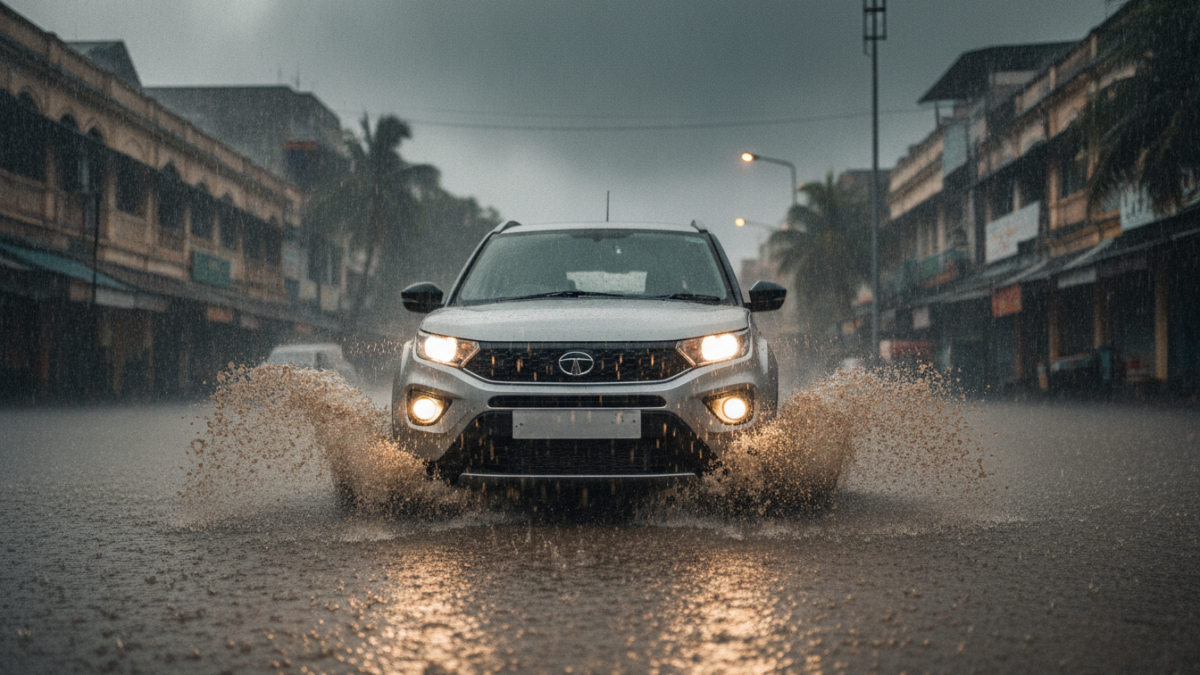
It happens every year, without fail. The first big rain of June lands, and within 48 hours the calls start coming in — “my car won’t crank”, “the brakes feel spongy”, “there’s a musty smell from the AC vents.”
The monsoon doesn’t just make driving harder. It quietly attacks your car — the electrics, the brakes, the tyres, the body panels, and if you’re really unlucky, the engine itself. Most of this damage is entirely preventable. Almost none of it is cheap to fix afterwards.
After years of driving through Indian monsoons and talking to service technicians about what lands on their ramps every season, I can tell you the same five problems show up like clockwork. Here’s what causes them, what to do the moment they happen, what the repair actually costs, and — most importantly — how to stay ahead of them.
In a hurry? The 5 problems in one line each:
- Engine stalling (water ingress) — the most expensive one
- Electrical failures — the most annoying one
- Brake problems — the most dangerous one
- Aquaplaning & grip loss — the most underestimated one
- Rust & corrosion — the slowest one
1. Engine Stalling Due to Water Ingress — The ₹3 Lakh Mistake
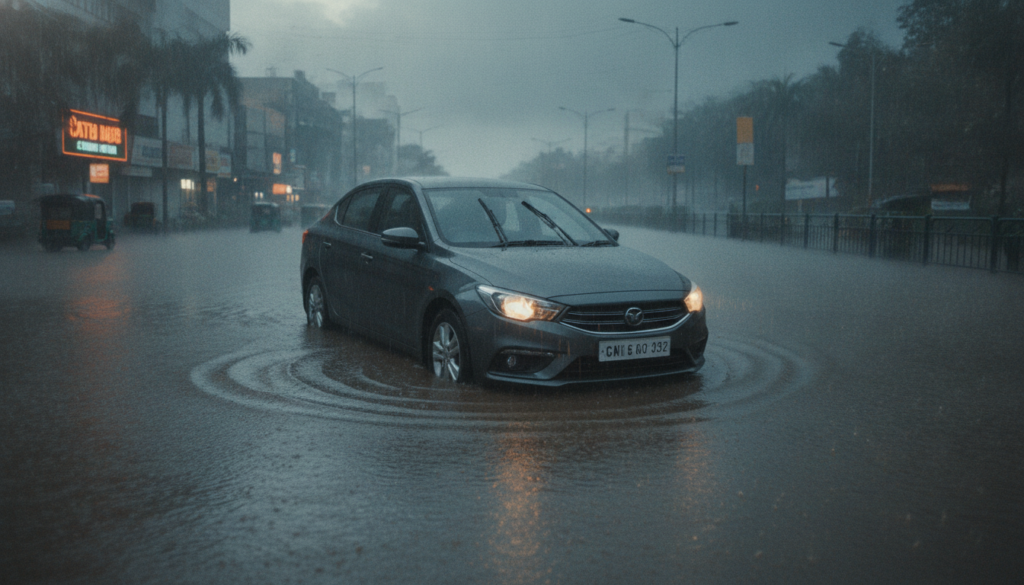
What you’ll notice: The engine suddenly cuts out mid-water, or cranks but won’t fire. Sometimes there’s a metallic clank when you turn the key, or power fades just before the stall.
Why it happens: Your engine works by compressing a fuel-air mixture. Here’s the problem — water doesn’t compress. If your air intake swallows even a modest gulp of water, a piston can come to a dead stop against it. That bends connecting rods, cracks components, and in the worst cases writes off the engine entirely. This is called hydro-lock, and diesels are particularly vulnerable because of their higher compression ratios.
The golden rule (read this twice): If your engine stalls in water, do not attempt to restart it. Not even once. One innocent crank with water inside the cylinders can turn a ₹2,000 tow-truck bill into a ₹2,00,000 engine rebuild. I’ve seen it happen to careful, sensible owners who thought “just one try” wouldn’t hurt.
What to do instead:
- Switch off everything. Don’t crank.
- Push or get the car towed to dry ground.
- If water reached high up the doors, disconnect the battery terminal.
- Call roadside assistance — most insurers and manufacturers include free RSA for the first few years.
- A mechanic needs to check three things before you even think about starting: the air filter (wet?), the dipstick (milky-brown oil = water inside), and the cylinders.
| Damage Level | Typical Repair Cost |
|---|---|
| Water in air filter only (lucky escape) | ₹500–2,000 (cleaning + new filter) |
| Hydro-lock, bent con-rod | ₹40,000–1,50,000 |
| Full engine replacement | ₹1,50,000–3,00,000+ |
💡 The insurance trap nobody tells you about: A standard comprehensive policy does not cover engine damage from water ingestion — it’s treated as consequential damage. You need the Engine Protect add-on (roughly ₹2,000–5,000/year depending on the car). If you live in a flood-prone city, buy this before the monsoon, not after the water recedes.
How deep is too deep? Never drive through water higher than half your tyre height. For most hatchbacks and sedans, that’s about 25–30 cm — roughly where your knee is on an average adult. And remember, the air intake sits lower than you’d guess on many sedans.
If you absolutely must cross (and I mean must):
- First gear, keep revs around 2,000 rpm, steady momentum — don’t lift off, don’t stop, don’t change gears mid-water
- Avoid crossing when an oncoming vehicle creates a bow wave
- Driving an automatic? Use manual mode or the lowest gear position
- Driving an EV? Battery packs are sealed to a much higher standard, but treat deep water with the same respect — don’t experiment
And honestly — if you can’t judge the depth, you can’t judge the depth. Turn around. Every time.
2. Electrical Failures — When the Small Things Stop Working
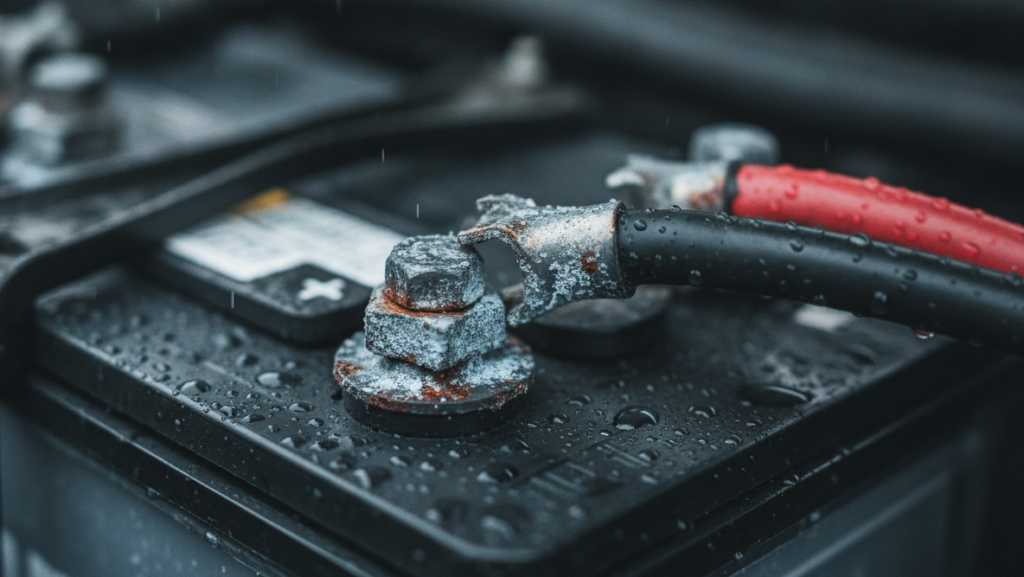
What you’ll notice: Power windows slowing down or dying, headlights dimming or flickering, the infotainment screen glitching, wipers misbehaving, or fogging inside the headlight lenses.
Why it happens: Moisture creeps into wiring connectors, the fuse box, and exposed terminals. Indian cars are especially exposed here — many wiring looms run along the floorboard, which is exactly where water pools in a flooded street or a leaking door seal.
What to do:
- Dielectric grease on connectors (₹200–400 a tube) — this is cheap insurance. Apply it to visible connectors and battery terminals before the season starts. Any local accessories shop stocks it.
- Anti-corrosion spray on battery terminals — a ₹150 spray prevents the white-green crust that causes starting trouble in humid weather.
- Get the fuse box inspected if you’ve driven through serious water — a technician will look for moisture tracks and corrosion.
- Headlight fogging: a light haze that clears after 20 minutes of driving is normal condensation. Persistent water pooling means the lamp seal has failed — get it resealed or replaced, or you’ll be replacing bulbs all season.
- After a wet spell, running the AC blower on high for 10–15 minutes helps dry out the dashboard electronics and cabin wiring.
When to DIY vs. see a mechanic: Grease and sprays — go ahead yourself. Anything involving opening wiring looms or the fuse box internals — leave it to the service centre. Electrical fires caused by amateur “fixes” are a genuine monsoon hazard.
3. Brake Problems — The One You Should Never Postpone
📸 IMAGE 4 Suggested: Close-up of a brake disc with surface rust / brake pad inspection Alt text: “Car brake squeaking in monsoon – wet brake discs and moisture in brake fluid India”
What you’ll notice: A squeal when braking, a pedal that feels soft or spongy, or stopping distances that feel longer than usual.
Why it happens: Three separate culprits, and it’s worth knowing which one you’re facing:
- Wet pads and discs. Water and mud coat the braking surfaces. Mild, temporary, and fixed by a few gentle brake applications.
- Overnight surface rust on rotors. In humid conditions, a fine orange film forms on discs literally overnight. This looks alarming but brushes off within the first few brake applications.
- Moisture-contaminated brake fluid. This is the serious one. Brake fluid is hygroscopic — it absorbs moisture from the air over time. Water in the fluid lowers its boiling point, and in hard, repeated braking (say, descending a ghat road in the rain) the fluid can boil, creating vapour and a pedal that goes to the floor.
What to do:
- After driving through water: while moving slowly and safely, brake lightly a few times to dry the discs and pads. Don’t do this at speed.
- Replace worn pads before the monsoon (₹2,500–6,000 for most cars under ₹15 lakh). Old pads plus wet roads is a combination I simply wouldn’t run.
- Spongy pedal? Get the fluid checked the same day. A brake fluid flush costs ₹800–2,000 — and manufacturers recommend replacement every two years anyway, which most owners in India conveniently forget. On wet roads, brakes are the one system where you cannot compromise.
4. Aquaplaning — When Your Car Floats
What you’ll notice: Light steering, a floating sensation, faint drift towards puddles, steering that responds vaguely — and then snaps back with a jolt once grip returns.
Why it happens: At a certain speed on a wet surface, your tyres can’t push water out of the way fast enough. The tyre rides up on a thin film of water, and for those seconds, you’re not really driving — you’re a passenger. This is aquaplaning, and the two things that decide whether it happens to you are tread depth and speed. Worn tyres can’t channel water away; under-inflated ones make it worse.
The checks that matter (do them this weekend):
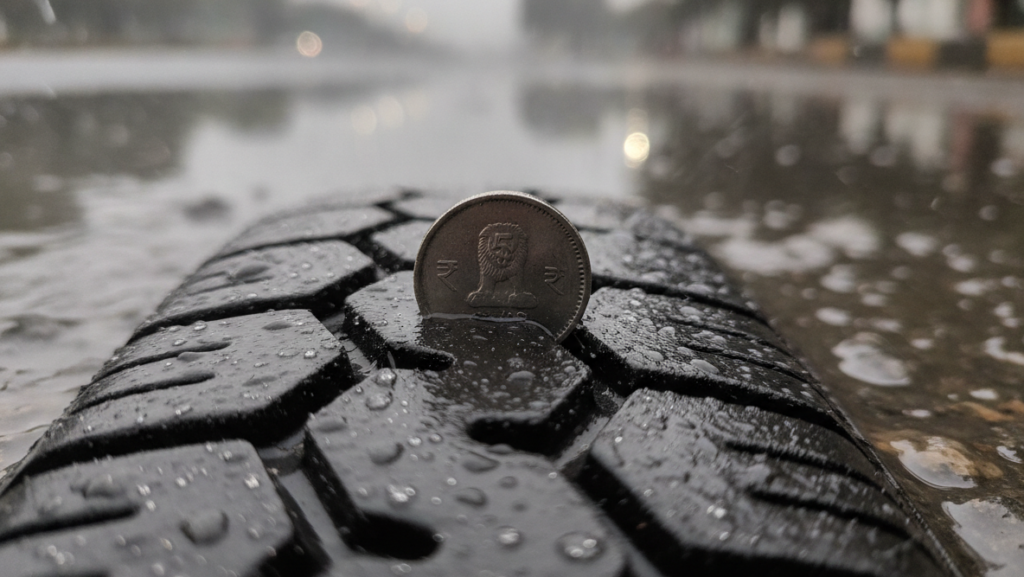
- Tread depth: The legal minimum in India is 1.6 mm, but for monsoon driving I’d replace anything under 3 mm. Use the ₹5 coin test — insert the coin in the groove; if the outer gold rim is fully visible, your tread is too shallow.
- Replace tyres if: they’re over 5 years old (check the DOT date stamp on the sidewall), show sidewall cracks or bulges, or have done 60,000+ km.
- Pressure: Check weekly, and always when tyres are cold. Monsoon temperature swings cause pressure fluctuation more than you’d expect.
- Consider a wet-grip focused tyre when you next replace — tyre makers publish wet grip ratings now, and the difference between a good and average tyre in the rain is genuinely large.
Driving technique in heavy rain: No cruise control. Double your following distance (aim for a 6-second gap). Every input — steering, braking, throttle — gentle. And slow down before the puddle, not in it. Braking mid-aquaplane is how cars end up pointing the wrong way.
5. Rust and Corrosion — The Slowest, Most Expensive Problem
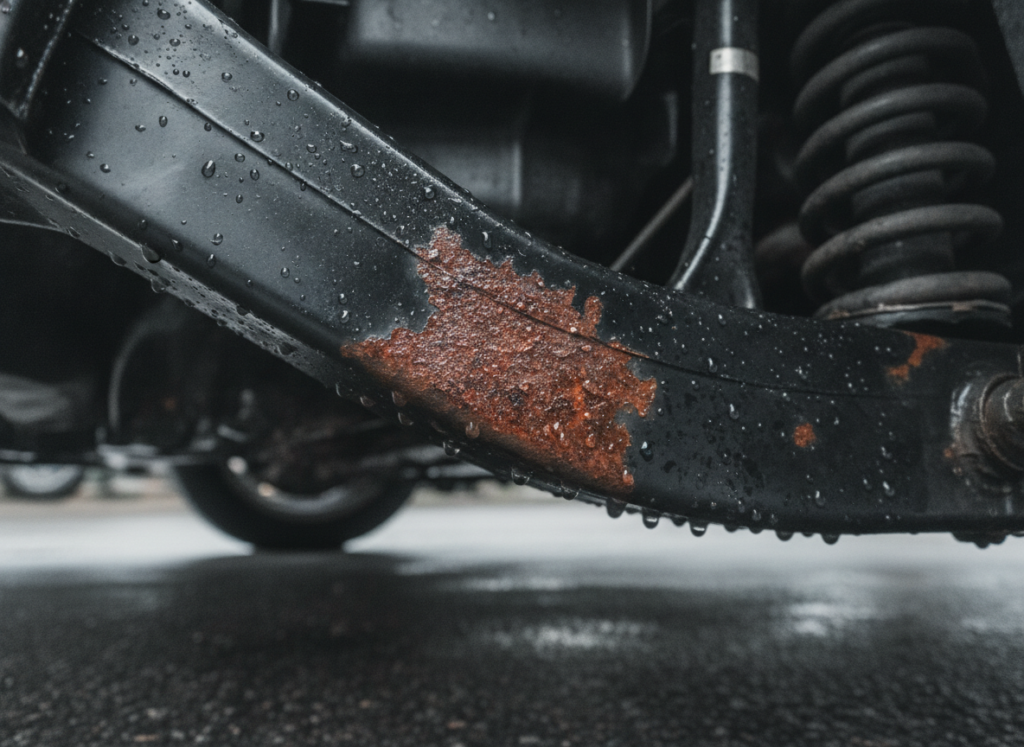
What you’ll notice: Bubbling or flaking paint, orange crust on door edges and hinges, rust spotting on the underbody or exhaust, brown streaks running from panel gaps.
Why it happens: Rainwater, mud, and humidity — with a special mention for the layer of road grime that holds moisture against the metal like a wet cloth. Add pollutants in city rainwater, which are mildly acidic, and you have a recipe for corrosion that starts in June and announces itself by Diwali.
Where it always starts first: door edges and lips, hinges, the underbody, around windscreen seals, and the exhaust system. Check those spots monthly through the season.
What to do:
- Pre-monsoon anti-rust / underbody coating: ₹2,500–4,500 at any good workshop. This is the single highest-return monsoon expense on this list.
- Wash weekly — including the underbody. Counter-intuitive, but rain doesn’t clean your car; the mud film it leaves does more harm than the water itself. A proper underbody wash once a fortnight matters more than the body shine.
- Touch up paint chips immediately (₹300–500). Every chip is an open door for rust, and monsoon walks right through it.
- Wipe door seals, hinges, and shuts dry after wet-weather drives so water doesn’t pool in the jams.
- Wax every 3 months. For new cars, ceramic coating (₹15,000–30,000) offers 3–5 years of protection — worth it if you plan to keep the car long-term, since paint condition directly hits resale value.
📋 Pre-Monsoon Checklist (Print This)
| # | Task | Why It Matters | Approx. Cost |
|---|---|---|---|
| 1 | Replace wiper blades if streaking | A ₹500 blade shouldn’t decide what you see at 80 km/h | ₹300–1,500 |
| 2 | Check tyre tread + pressure | Your only contact with the road | Free (air) / coin test |
| 3 | Inspect brake pads + fluid | Covered above — non-negotiable | ₹800–2,000 (fluid) |
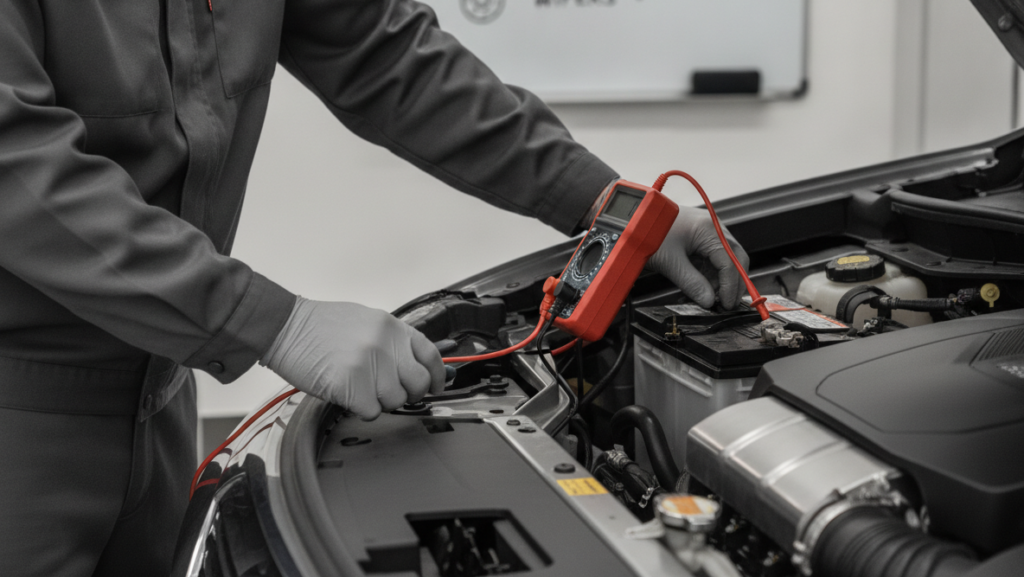
| 4 | Battery health test | Humidity + short trips drain batteries faster | Free–300 (most workshops) |
| 5 | Test all lights — head, tail, fog, brake | Rain cuts visibility; dead lights cut it more | — |
| 6 | Inspect rubber door/window seals | Failed seals leak water onto wiring and floors | — |
| 7 | Clear AC drain tube + replace cabin filter | Prevents that musty smell and wet carpets | ₹500–1,200 |
| 8 | Underbody anti-rust coating | The best money on this list | ₹2,500–4,500 |
| 9 | Save RSA number in your phone | When you need it, you’ll need it fast | — |
| 10 | Add Engine Protect to your insurance | The ₹3,00,000 question | ₹2,000–5,000/year |
Emergency kit for the boot: tow rope, first-aid kit, torch, spare fuses, a small umbrella, a power bank, and an old towel. Sounds like overkill until the day it isn’t.
🚨 If Your Car Was Parked in a Flooded Area
Water above the door sill while parked? Do these five things, in order:
- Do not start the engine or insert-and-turn the key. Same hydro-lock rule applies.
- Disconnect the battery.
- Pull the dipstick and check the air filter. Milky oil or a soaked filter = mechanic, immediately.
- Don’t sit in the car or power the windows if water touched the seats — wet wiring under seats can short.
- Get it inspected before any restart — and document everything with photos for the insurance claim.
The Bottom Line
The monsoon doesn’t attack your car all at once — it picks at it, one connector, one brake application, one puddle at a time. Almost everything on this list costs under ₹5,000 to prevent and over ₹50,000 to fix. That’s the whole math of monsoon car care.
And if the water ahead looks too deep to judge? It is. Turn around. Your car — and your wallet — will thank you.
❓ Frequently Asked Questions
Q1: Can I drive through waterlogged roads? Only if water is below half the wheel height (~25–30 cm for most cars). First gear, revs above 2,000 rpm, steady momentum, never stop mid-water. Deeper than that? Take the detour — water-damaged engine repairs range from ₹3,000 to over ₹3,00,000.
Q2: How do I know if my engine took in water? Engine stalled in water and won’t restart, metallic clanking while cranking, milky-brown oil on the dipstick, or a soaking-wet air filter. If you see any of these, do not crank again — call roadside assistance.
Q3: Why does my car AC smell bad in the monsoon? Fungal and bacterial growth on the AC evaporator coil and cabin filter. Fix: replace the cabin filter (₹500–1,200), use an AC vent cleaning spray (₹500), or get professional AC disinfection (₹1,500–3,000). Habit that prevents it: run the fan (no AC) for 2–3 minutes before switching off, so the evaporator dries.
Q4: When should I replace tyres before the monsoon? Replace if tread depth is under 3 mm (₹5 coin test), the tyres are over 5 years old, there are sidewall cracks or bulges, or you’ve crossed 60,000 km on the set.
Q5: How do I stop my car from rusting in the monsoon? Pre-monsoon underbody anti-rust coating (₹2,500–4,500), weekly washes including the underbody, immediate touch-ups on chips (₹300–500), wax every 3 months. Ceramic coating (₹15,000–30,000) for new cars held long-term.
Q6: Does car insurance cover monsoon water damage? Partially. A standard comprehensive policy covers flood damage to interiors and electricals, but not engine damage from water ingestion — that needs the Engine Protect add-on (₹2,000–5,000/year). Buy it before the monsoon; insurers often reject add-ons purchased mid-season or after a flood warning.
Q7: I’m buying a used car after the monsoon — how do I check for flood damage? Check for: musty smell even after “cleaning”, waterline marks in the boot under the carpet, rust under seats and on seat rails, fogging inside the headlights, moisture in the fuse box, and mismatched or corroded wiring connectors. Ask for service history, and get a pre-purchase inspection — flood-repaired cars often look fine for six months before the electricals start failing one by one.
👤 About the Author
Amol Rajendra Pawar is an automobile technician and automotive blogger with hands-on experience since 2007. He has worked in technical and quality-control roles with brands including Ford, Toyota, Škoda, Nexa, Tata Motors, MG and Volkswagen.
Through AAutoMobiles.in, he shares practical automotive knowledge, car maintenance tips and buying advice to help readers make better decisions.
📚 Sources & References
- Manufacturer owner’s manuals — wading depth and parking-in-flood guidance (Tata Motors, Maruti Suzuki, Hyundai)
- IRDAI standard motor insurance add-on terms — Engine Protect / Return to Invoice coverage
- CMVR (Central Motor Vehicles Rules) — minimum tread depth requirement
- Tyre manufacturer wet-grip data and testing (MRF, Apollo, CEAT technical resources)
- Service cost estimates: authorised service centre rate cards, Delhi NCR (2026)
⚠️ Disclaimer
Repair costs are indicative ranges for cars under ₹15 lakh in metro cities and vary by model, city, and workshop. This article is general guidance, not a substitute for inspection by a qualified technician. When in doubt — especially about brakes, water ingress, or electricals — always consult your authorised service centre.

Related Articles