Regenerative Braking in EVs: How It Works, Benefits, Limitations and Real-World Tips

By Amol Rajendra Pawar | AautoMobiles.in
Updated: September 2026
If you have recently driven an electric car, you may have noticed something different from a petrol or diesel car.
When you release the accelerator, the EV may start slowing down without pressing the brake pedal.
This is not just normal engine braking. It is called regenerative braking, or simply regen braking.
Regenerative braking allows an EV to recover some of the energy that would normally be lost when the vehicle slows down. The electric motor works as a generator during deceleration and sends the recovered electrical energy back to the high-voltage battery.
It can improve overall efficiency and reduce brake-pad wear, especially in city traffic where the vehicle frequently accelerates and slows down.
But regenerative braking is not magic. It cannot recover all the energy used to move the car, and its performance can change depending on battery temperature, battery charge level, vehicle speed and the driving conditions.
So, how exactly does it work?
What Is Regenerative Braking?
Regenerative braking is a system used in electric vehicles and hybrid vehicles to recover some of the vehicle’s kinetic energy during deceleration.
In a conventional car, when you press the brake pedal, the friction between the brake pads and discs converts much of the vehicle’s kinetic energy into heat.
That heat is then lost to the surroundings.
In an EV, the electric motor can work in the opposite direction during deceleration.
Instead of using electrical energy from the battery to turn the wheels, the rotating wheels turn the motor. The motor then works like a generator and produces electrical energy.
That recovered energy can be sent back to the battery.
The basic idea is:
Vehicle movement → Electric motor → Electrical energy → Battery
The process is one reason electric and hybrid vehicles can be particularly efficient in stop-and-go driving.

How Does Regenerative Braking Work?
The process is easier to understand if we look at it step by step.
1. The EV is moving
The battery supplies electrical energy to the motor.
The motor produces torque and turns the wheels, moving the vehicle forward.
2. The driver releases the accelerator
When the driver lifts the accelerator pedal, the vehicle’s control system can request negative torque from the motor.
This creates a slowing force at the wheels.
Depending on the vehicle and selected driving mode, the amount of deceleration can vary.
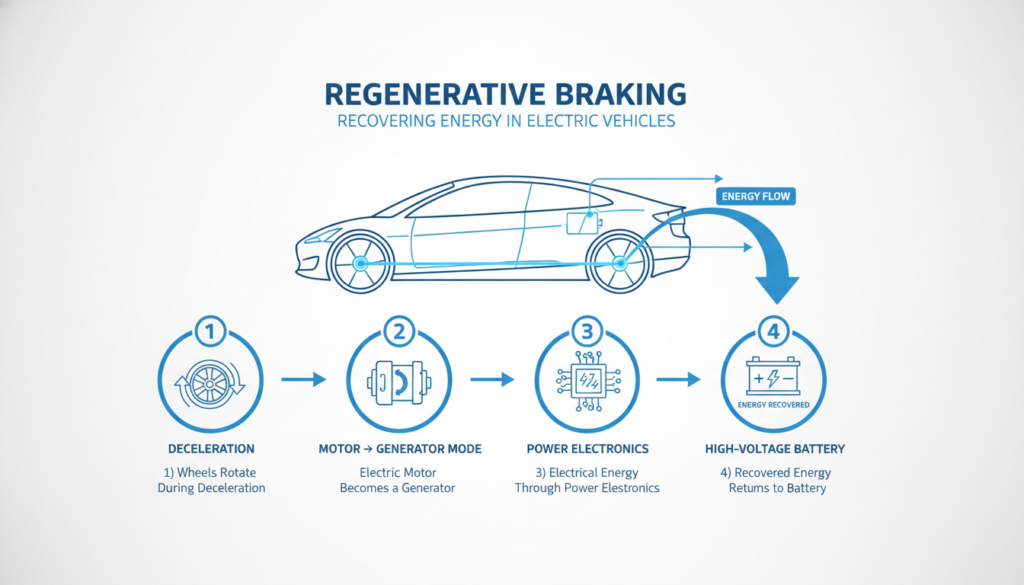
3. The motor becomes a generator
Instead of consuming electrical energy to drive the wheels, the motor is driven by the rotating wheels.
It now works as a generator.
4. Electricity is produced
The mechanical energy from the rotating wheels is converted into electrical energy.
The vehicle’s power electronics control this energy flow.
5. Energy goes back to the battery
The recovered electrical energy is sent to the high-voltage battery, within the limits allowed by the battery management and charging system.
This energy can later be used again to move the vehicle.
The U.S. Department of Energy describes the same basic principle: the electric motor operates as a generator during braking and recovered energy is stored in the battery.
Regenerative Braking: Simple Energy Flow
Battery → Motor → Wheels → Vehicle Movement
During regeneration:
Wheels → Motor/Generator → Power Electronics → Battery
This is why the same motor that helps move the vehicle can also help slow it down and recover energy.
Does Regenerative Braking Work Only When You Press the Brake?
No.
This is one of the most common misunderstandings about EV braking.
In many EVs, regenerative braking can begin when the driver simply releases the accelerator pedal.
The strength of this deceleration depends on the vehicle’s design and the selected regeneration setting.
Some EVs offer different levels of regeneration, while some models provide a stronger one-pedal driving experience.
In some vehicles, regenerative braking can also work together with the friction brakes when the driver presses the brake pedal.
The exact behaviour is different from one EV to another, so the owner’s manual is the best source for the specific vehicle.
For example, Tesla’s current owner’s manuals explain that regenerative braking can slow the vehicle when the accelerator is released and that the amount of regeneration can vary with battery conditions.
What Is One-Pedal Driving?
One-pedal driving is a driving feature made possible by strong regenerative braking.
When the driver accelerates, the vehicle moves normally.
When the driver gradually releases the accelerator, the regenerative system increases deceleration and the vehicle slows down significantly.
In some EVs, the vehicle can come to a complete stop without the driver continuously using the brake pedal.
However, one-pedal driving does not mean the brake pedal becomes unnecessary.
The driver must still be ready to use the brake pedal whenever stronger or emergency braking is required.

Regenerative Braking vs Conventional Braking
The biggest difference is what happens to the vehicle’s kinetic energy.
| Feature | Regenerative Braking | Friction Braking |
|---|---|---|
| Main purpose | Slow the vehicle and recover energy | Slow or stop the vehicle |
| Energy behaviour | Some energy is recovered | Mostly converted into heat |
| Motor involved | Yes | No |
| Brake pads used | Usually reduced use | Used normally |
| Battery charging | Can send energy back to battery | No |
| Useful for | Normal deceleration | Strong and emergency braking |
Modern EVs generally combine regenerative braking with conventional friction braking rather than depending on regeneration alone.
Why Do EVs Still Need Normal Brakes?
This is an important point.
Regenerative braking does not completely replace friction brakes.
There are situations where the vehicle needs more braking force than the motor can provide.
For example:
- Emergency braking
- Very low vehicle speed
- Battery near full charge
- Cold battery conditions
- Situations where regeneration is limited
- When the vehicle’s control system decides friction braking is required
The conventional brake system therefore remains an important safety system.
Some EVs automatically blend regenerative and friction braking to provide smooth deceleration.
What Happens When the EV Battery Is 100% Charged?
This is something EV owners should understand.
A battery that is already at or near its charging limit has less room to accept additional energy.
As a result, regenerative braking can be reduced when the battery is fully charged.
This can change the normal feeling of deceleration when you release the accelerator.
Some EVs compensate by increasing the use of conventional friction brakes.
The exact behaviour depends on the vehicle and its software.
So, if your EV feels different immediately after a full charge, it does not automatically mean there is a fault.
Always follow the warning messages and instructions provided by the vehicle manufacturer.
What Happens to Regenerative Braking When the Battery Is Cold?
Battery temperature also matters.
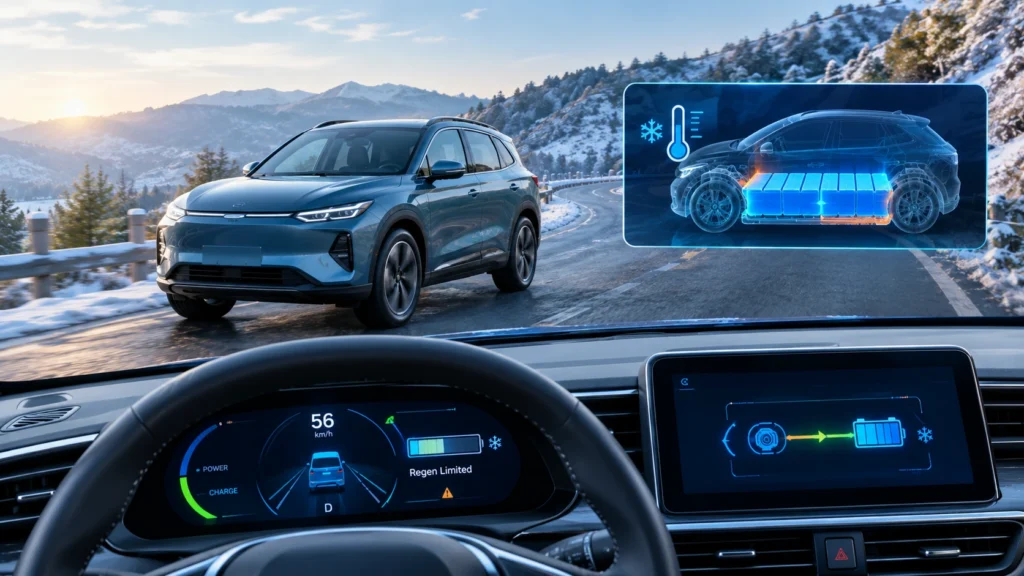
A cold high-voltage battery may not be able to accept regenerative charging at the same rate as a battery operating within its preferred temperature range.
Because of this, the vehicle may temporarily reduce regenerative braking.
As the battery warms up during driving, regenerative braking may gradually become stronger again.
Tesla’s owner’s manuals, for example, specifically note that regenerative braking can be limited when the battery is cold.
This is an important practical point for EV owners because the braking feel can be different during the first few kilometres of a cold drive.
Battery Temperature Limitation
Does Regenerative Braking Increase EV Range?
Yes, but it is important to understand what that means.
Regenerative braking does not create free energy.
The vehicle first uses energy to accelerate and move forward. During deceleration, the system recovers some of the energy that would otherwise be lost.
There are electrical, mechanical and battery-related losses in the complete energy conversion process.
Therefore, not all of the energy used during acceleration can be recovered.
The real benefit is that some otherwise wasted energy is reused.
The effect can be particularly useful in city driving, where vehicles frequently slow down and accelerate again. The U.S. Department of Energy notes that city driving can maximize regenerative-braking benefits because of frequent stops.
Why Is Regenerative Braking Useful in City Traffic?
Imagine driving through a busy city.
You accelerate from a traffic signal.
A few seconds later, traffic slows down.
You release the accelerator and the EV begins to decelerate.
The motor can recover part of that vehicle energy.
Then you accelerate again.
This cycle happens repeatedly.
In a conventional vehicle, much of the braking energy is lost as heat through the brake system.
In an EV, some of that energy can be recovered and stored.
This is one reason regenerative braking is especially useful in stop-and-go traffic.
Benefits of Regenerative Braking
1. Better Energy Efficiency
Some energy that would otherwise be lost during deceleration can be recovered.
2. Reduced Brake Wear
Because the motor can provide part of the deceleration, friction brakes may be used less frequently.
This can reduce brake-pad and rotor wear over time.
3. Useful in City Driving
Frequent acceleration and deceleration provide more opportunities for energy recovery.
4. Smooth Driving
When properly calibrated, regenerative braking can provide smooth and predictable deceleration.
5. One-Pedal Driving
Strong regeneration can allow some EVs to provide one-pedal driving in suitable conditions.
Limitations of Regenerative Braking
Regenerative braking has several limitations that EV owners should know.
Low-Speed Behaviour
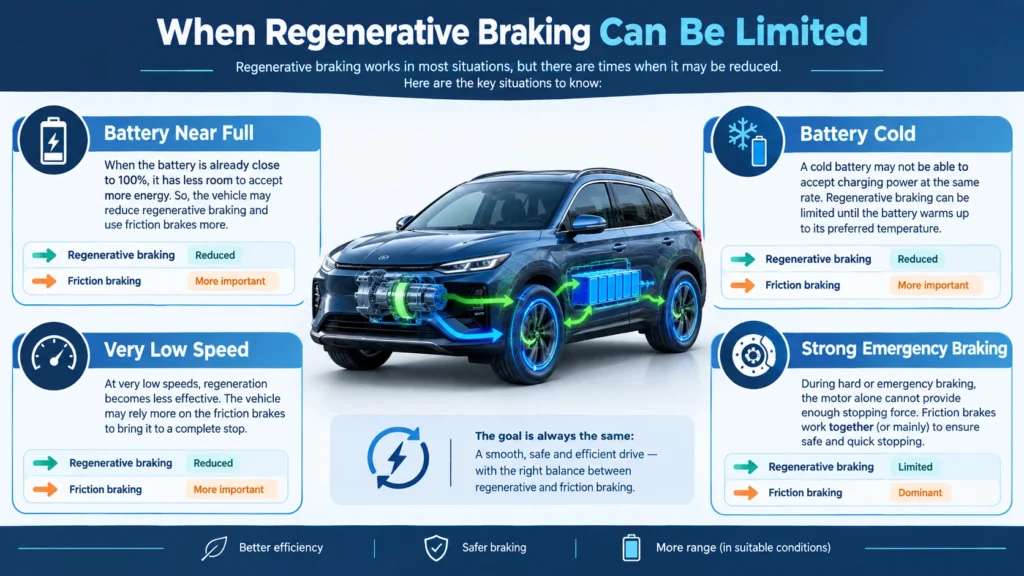
Regeneration may become less effective as vehicle speed becomes very low, so friction braking may still be needed to bring the vehicle to a complete stop.
Full Battery
When the battery is already near full charge, the system may reduce regenerative charging.
Cold Battery
A cold battery can temporarily limit regenerative braking.
Maximum Motor Regeneration
The motor and power electronics have limits on how much energy they can safely recover.
Driving Conditions
Regeneration cannot recover energy that has already been lost through aerodynamic drag, rolling resistance or other losses.
“When Regen Is Strong vs Limited”
Can Regenerative Braking Damage the EV Battery?
Under normal operation, the vehicle’s battery management system controls how much regenerative energy can be accepted by the battery.
The system considers factors such as battery state of charge and temperature.
Therefore, the driver does not manually control the electrical charging current during regeneration.
However, regenerative braking should not be misunderstood as a way to “charge the battery for free.”
It simply recovers a portion of energy during deceleration that would otherwise be lost.
How Can an EV Driver Use Regenerative Braking Better?
If your EV has adjustable regeneration, there are a few practical habits that can make driving smoother.
1. Look Ahead
Do not accelerate hard toward a red light and then brake suddenly.
Instead, anticipate the traffic and gradually release the accelerator.
2. Use Regeneration During Normal Deceleration
Allow the vehicle to slow down through regeneration when road and traffic conditions are suitable.
3. Do Not Avoid the Brake Pedal
If you need to stop quickly, use the brake pedal.
Safety is always more important than recovering a small amount of energy.
4. Learn Your EV’s Regen Settings
Different cars use different terminology and regeneration levels.
Spend some time understanding how your particular EV behaves.
5. Pay Attention After a Full Charge
If the battery is near 100%, the car may feel different because regenerative braking can be limited.
Regenerative Braking on Downhill Roads
Downhill driving is another situation where regenerative braking can be useful.
When the vehicle travels downhill, gravity increases the vehicle’s speed.
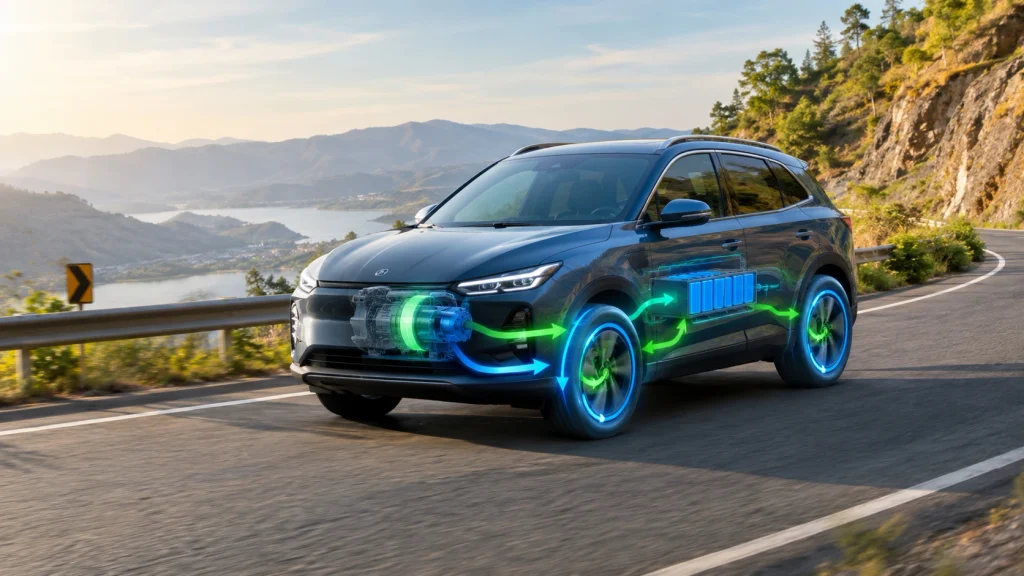
Instead of continuously using the friction brakes, the driver may be able to use regenerative braking to control speed, depending on the vehicle and road conditions.
However, drivers should never rely only on regeneration on a steep or long descent.
If additional braking is required, use the brake pedal.
Vehicle speed, road gradient, traffic and safety must always come first.
Downhill Regeneration
A Simple Real-World Example
Suppose you are driving an EV in city traffic.
You accelerate from a signal and reach 50 km/h.
A few hundred metres later, traffic begins to slow.
Instead of accelerating until the last moment and then applying the brakes heavily, you release the accelerator earlier.
The vehicle begins to decelerate.
The motor produces negative torque and acts as a generator.
Some of the vehicle’s kinetic energy is converted into electrical energy and returned to the battery.
If stronger braking is required, the friction brakes can assist.
This is regenerative braking in everyday driving.
Does Every EV Have the Same Regenerative Braking?
No.
The behaviour varies between vehicles.
Different manufacturers may use different:
- Motor designs
- Battery chemistries
- Power electronics
- Regeneration strategies
- Driving modes
- Brake blending systems
- One-pedal driving settings
Even two EVs with similar battery capacities can feel completely different when the accelerator is released.
So, when buying an EV, don’t judge regenerative braking only by the battery capacity or claimed range.
Take a proper test drive and understand the braking feel.
Regenerative Braking: What an EV Owner Should Remember
Here are the most important points:
- Regenerative braking converts some vehicle kinetic energy into electrical energy.
- The electric motor works as a generator during regeneration.
- The recovered energy can be sent back to the high-voltage battery.
- Regeneration can reduce the use of friction brakes.
- City traffic can provide more opportunities for energy recovery.
- Regenerative braking does not recover 100% of the energy used by the vehicle.
- A battery near full charge may limit regeneration.
- A cold battery can also limit regeneration.
- Friction brakes are still essential for strong and emergency braking.
- One-pedal driving is a feature based on strong regenerative deceleration, not a replacement for safe braking habits.
Frequently Asked Questions
1. What is regenerative braking in an EV?
Regenerative braking is a system that allows an electric motor to work as a generator during deceleration and recover some of the vehicle’s kinetic energy.
2. Does regenerative braking charge the battery?
Yes. Some of the recovered electrical energy can be sent back to the high-voltage battery, within the limits of the battery and vehicle system.
3. Does regenerative braking increase range?
It can improve overall energy efficiency and help extend practical driving range by recovering some energy that would otherwise be lost during deceleration.
4. Does regenerative braking work when I release the accelerator?
In many EVs, yes. Releasing the accelerator can request regenerative deceleration, depending on the vehicle’s settings and operating conditions.
5. Can regenerative braking replace brake pads completely?
No. EVs still require conventional friction brakes for situations where stronger braking is needed and when regeneration is limited.
6. Why is regenerative braking weaker after charging to 100%?
A battery near its maximum charge level has less capacity to accept additional energy, so the vehicle may temporarily reduce regenerative charging.
7. Why is regen braking sometimes weak when the EV is cold?
A cold battery may have limited ability to accept charging power. The vehicle can therefore reduce regenerative braking until the battery reaches a suitable operating temperature.
8. Is regenerative braking the same in every EV?
No. Regeneration strength, driving modes, brake blending and one-pedal behaviour vary between manufacturers and models.
9. Is regenerative braking useful on highways?
It can recover energy during suitable deceleration, but highway driving generally provides fewer braking opportunities than stop-and-go city driving.
10. Should I use the brake pedal in an emergency?
Yes. Never avoid the brake pedal just to increase energy recovery. Safe stopping should always be the priority.
Final Takeaway
Regenerative braking is one of the smartest parts of an electric vehicle’s powertrain.
Instead of allowing all the vehicle’s kinetic energy to disappear as heat during deceleration, the EV can recover a portion of that energy and send it back to the battery.
But there is an important point many new EV owners miss:
Regenerative braking does not create energy. It recovers some of the energy that the vehicle has already used.
Its effectiveness also changes with battery charge, temperature, speed, driving conditions and the vehicle’s control system.
Once you understand how regeneration works, EV driving becomes much easier to understand—and you can make better use of the technology without depending on it when strong braking is required.
Sources & Further Reading
- U.S. Department of Energy — Alternative Fuels Data Center: Electric Vehicle Basics
- U.S. Department of Energy — Electric Vehicle Technology Overview
- U.S. Department of Energy — EV Maintenance and Safety
- Manufacturer owner’s manuals for regenerative braking behaviour
Note: Regenerative braking behaviour differs by EV model. Always refer to the vehicle owner’s manual for model-specific operation, warnings and recommended driving practices.

Related Articles